Changing an NVIDIA card's VBIOS used to mean flashing new firmware and hoping nothing went wrong. A developer called Panchovix has released tools that skip that step for GeForce RTX 50, 40 and 30 cards, with experimental support for older Turing cards.
The NVIDIA VBIOS Vix Editor lets you change power limits, voltage limits, clock offset ranges and fan settings on a saved copy of your VBIOS. That copy is then loaded through the NVIDIA driver instead of written to the card. On Windows, a loader uses a registry override and restarts the GPU, and on Linux it uses modified NVIDIA open kernel modules at boot. The original firmware on the card stays as it was, and you can go back to the default settings.
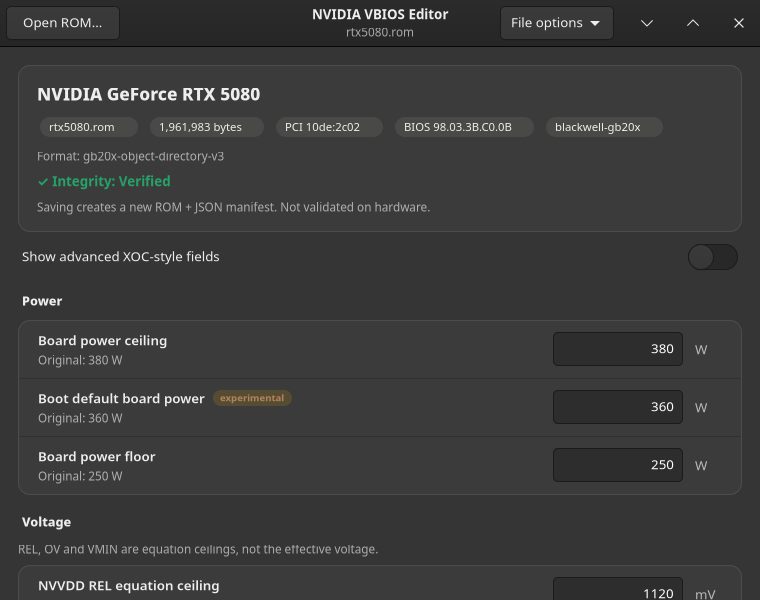
The developer's demos raised an RTX 5090's power limit from 600W to 800W and an RTX 5080's from 360W to 500W. Those are the limits that can be set, not measured gaming power draw or performance gains. You can also go the other way and set lower power limits than the usual software allows.
It comes with real risks. Pushing these limits can cause instability, overheating, too much current through the power connectors or permanent damage, and not flashing the card doesn't make that safe. The Windows loader works with drivers 616.56 and newer in the tested 616.x and 617.x branches, the Linux version targets 615.x, and NVIDIA could block the override in a future driver.