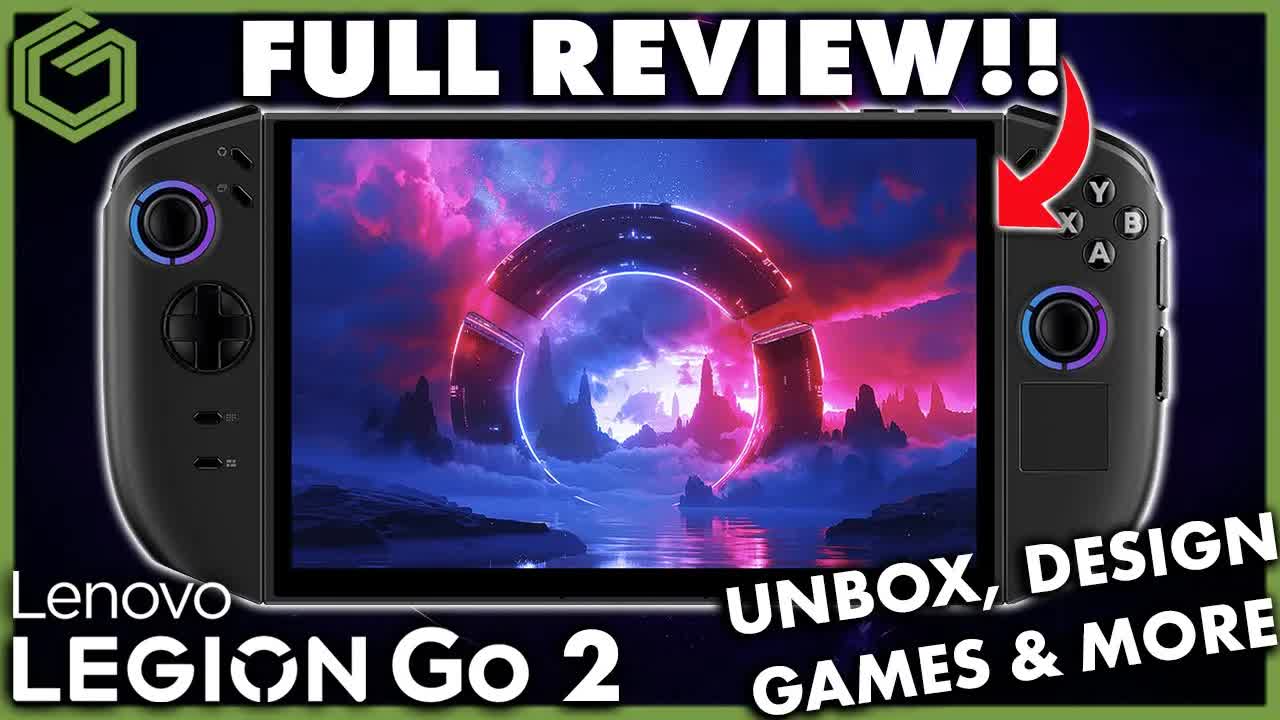
 ▶Watch on YouTube
The Lenovo Legion Go 2 is the true successor to the original Legion Go Z1 Extreme from 2023. By the time I finished this review, I'd had the Go 2 with the Z2 Extreme for about a month. I bought this one myself: $1,349, or $1,440 with tax. It's a premium, much improved device over the original in almost every way, but the price is a big part of the story.
- A more premium look and feel, better ergonomics, great buttons and triggers, and night-and-day better speakers than the original Go.
- The 8.8-inch 1200p OLED with 144Hz VRR and HDR is one of the best displays I've personally used on a handheld.
- The Z2 Extreme's efficiency is the standout. The FPS leap over the Z1 Extreme is around 10 to 20%, but I can run 15 to 20W where I used 20 to 25W on the original Go.
- It's still large and heavy, and a bit thicker and heavier than the original. The included soft case is a downgrade.
- At $1,349 it's twice the original Go's $699 launch price.
Unboxing
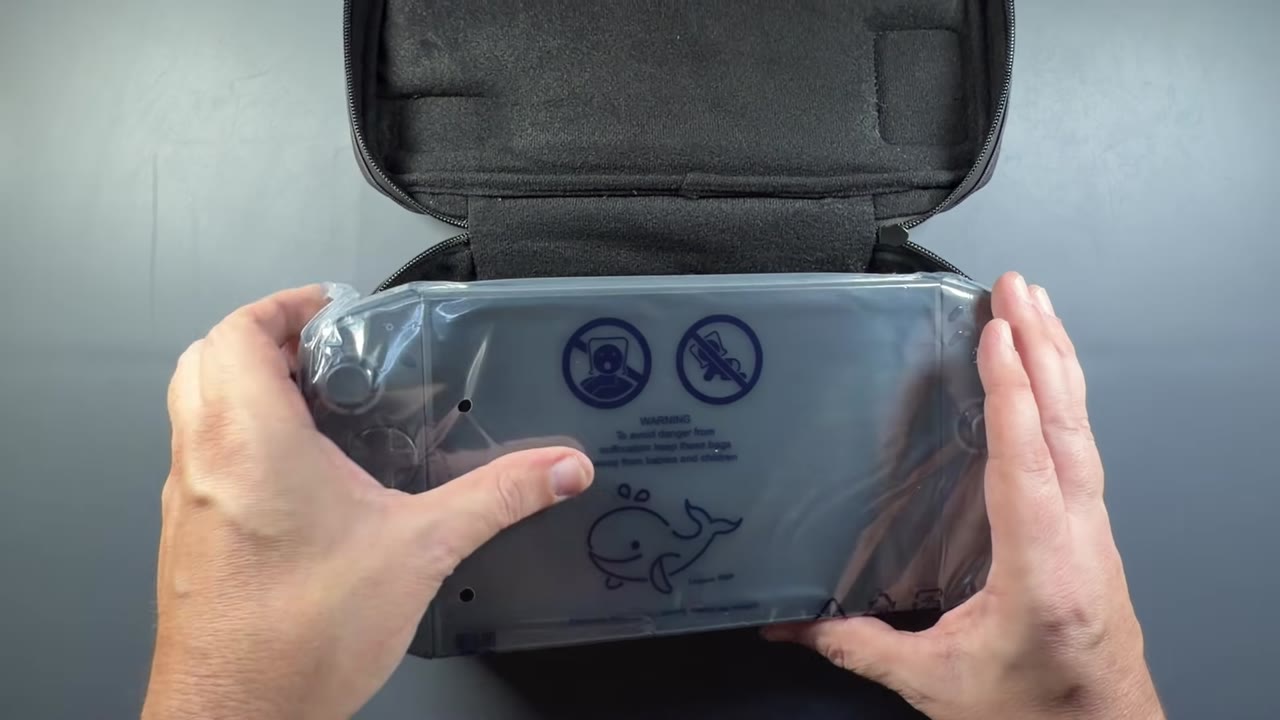
I covered a full unboxing and first impressions in another video, so this is quick. In the box you get the 65W charger, which is pretty typical, the Legion Go 2 itself, a bit of paperwork and the cardboard stand you can put together if you want. I'm happy we still get a case, like with the original Go. What I don't like, for the amount we pay for this device, is that the new soft-style case is a major downgrade. It still fits the accessories minus the charger, much like the original case, but it's just not nearly as nice to deal with or use.
Specs
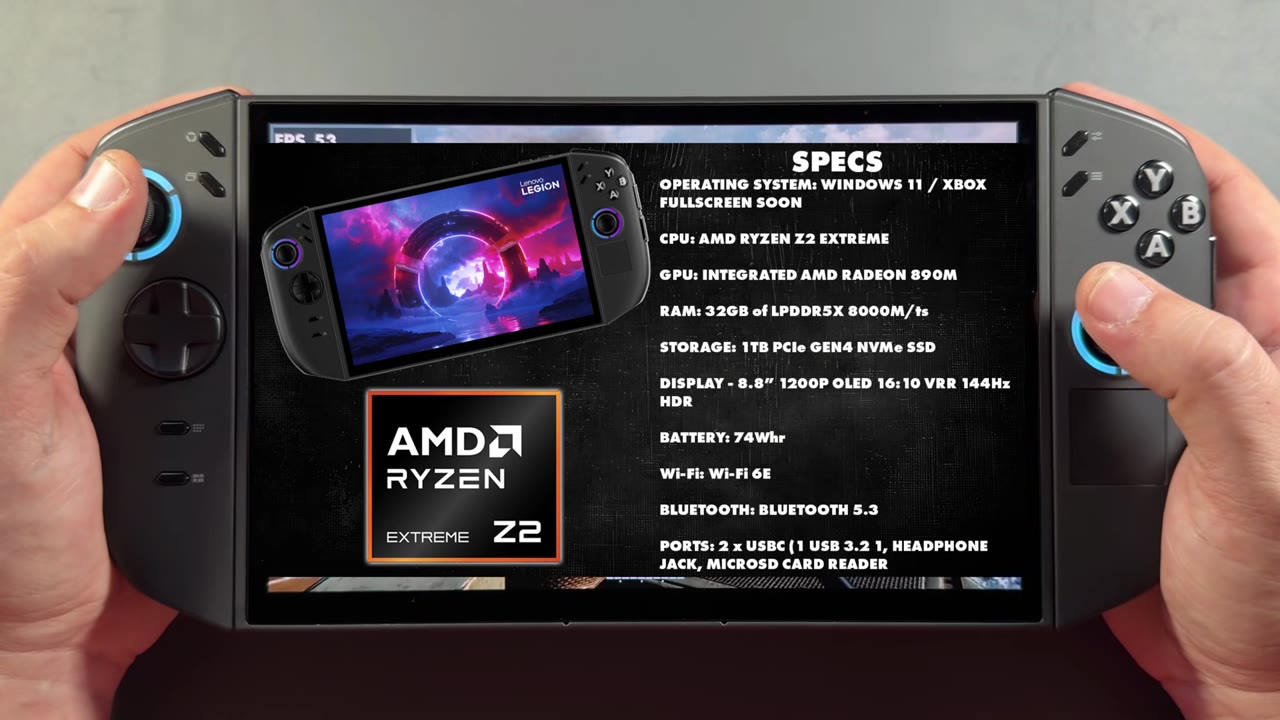
- AMD Ryzen Z2 Extreme with integrated Radeon 890M graphics
- 32GB LPDDR5X-8000
- 1TB M.2 2280 PCIe 4.0 SSD
- 8.8-inch 16:10 1200p OLED, 144Hz VRR, HDR
- Two USB-C ports, Wi-Fi 6E, Bluetooth 5.3 and a built-in fingerprint sensor
- 74Wh battery, a bump up from the original Go
Design and comfort
The Go 2 has a more premium look and feel than the original. The materials have a soft matte feel and finish that's hard to describe, and it's really nice to hold, both the device itself and the removable controllers. It's still large and heavy, but it feels very premium and expensive, which makes sense for this version of the Go.
Next to the original, the Go 2 weighs a little more, and you can see right away that it's thicker and feels bulkier. Even so, it's more comfortable and much improved in ergonomics. It's still not as comfortable as something like the Xbox Ally X or the Steam Deck, but it's much better than the original. It keeps the great, high-quality built-in kickstand, the removable controllers and the mouse mode features.
I still don't like the extra side buttons on the right controller. I still hit them by accident sometimes, which can be frustrating, but they're designed better this time and harder to push, and I'm getting better about it. The build quality of all the buttons and triggers is great this time around, much better than what I called the louder, clunkier buttons of the Xbox Ally X in my recent review.
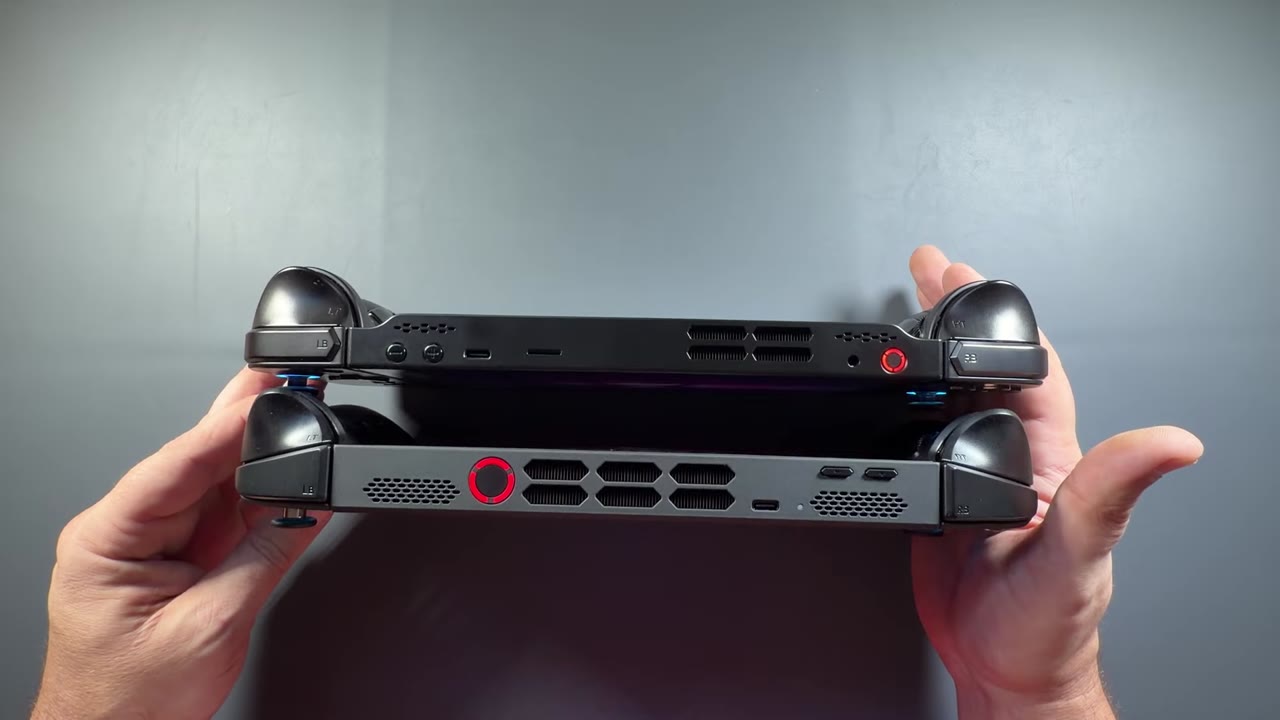
A major improvement over the original Go is the speakers. Compared with how bad the original's speakers were, it's a night-and-day difference. I'm glad Lenovo listened with all these design changes, including the speaker upgrade.
The display
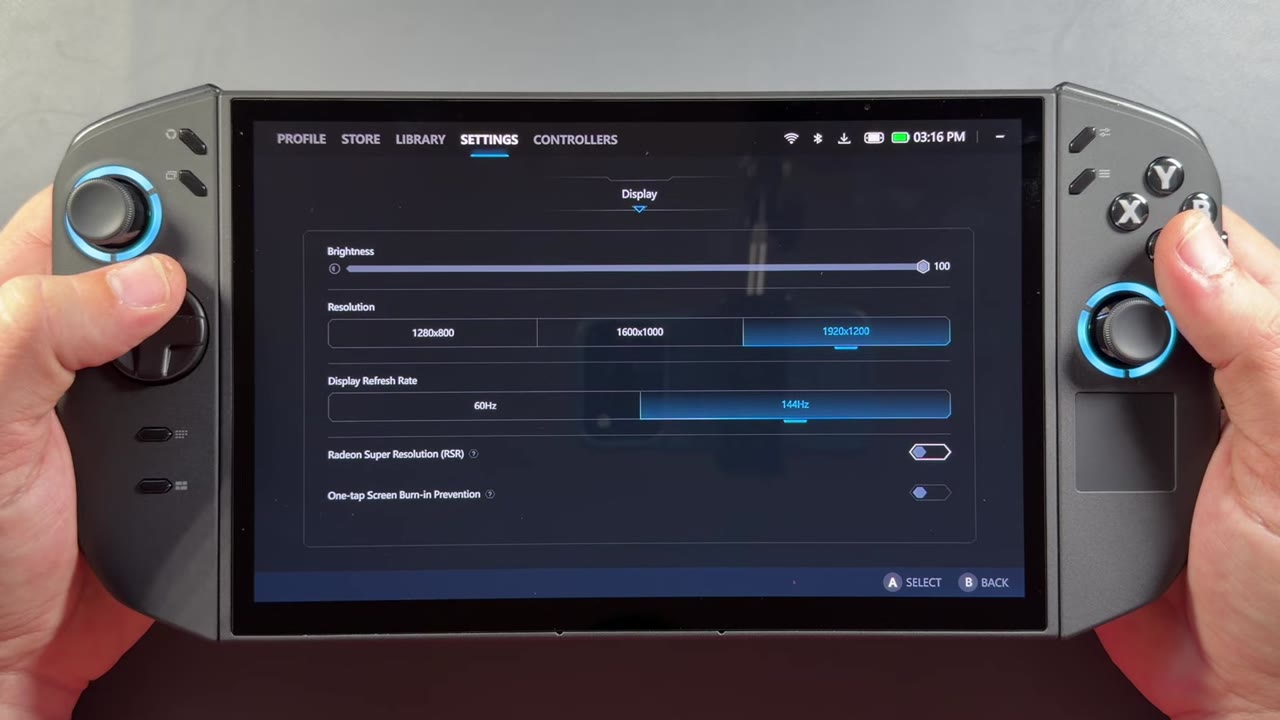
The screen deserves its own spot. This 8.8-inch HDR OLED is fantastic and one of the best displays I've personally used on a handheld: bright and beautiful, 144Hz, with VRR from 30 to 144 FPS. Lenovo brought it down to 1200p from the original's 1600p while keeping the 16:10 aspect ratio. In my opinion that was a great move for the power these devices have, and 800p, 1000p and 1200p can all look great depending on the game.
Besides the build quality, the OLED is clearly part of the reason for the higher price, since Lenovo went for more of an enthusiast build with this device. That comes with good and bad trade-offs depending on who you are, but at the end of the day it's a top-of-the-line OLED handheld display.
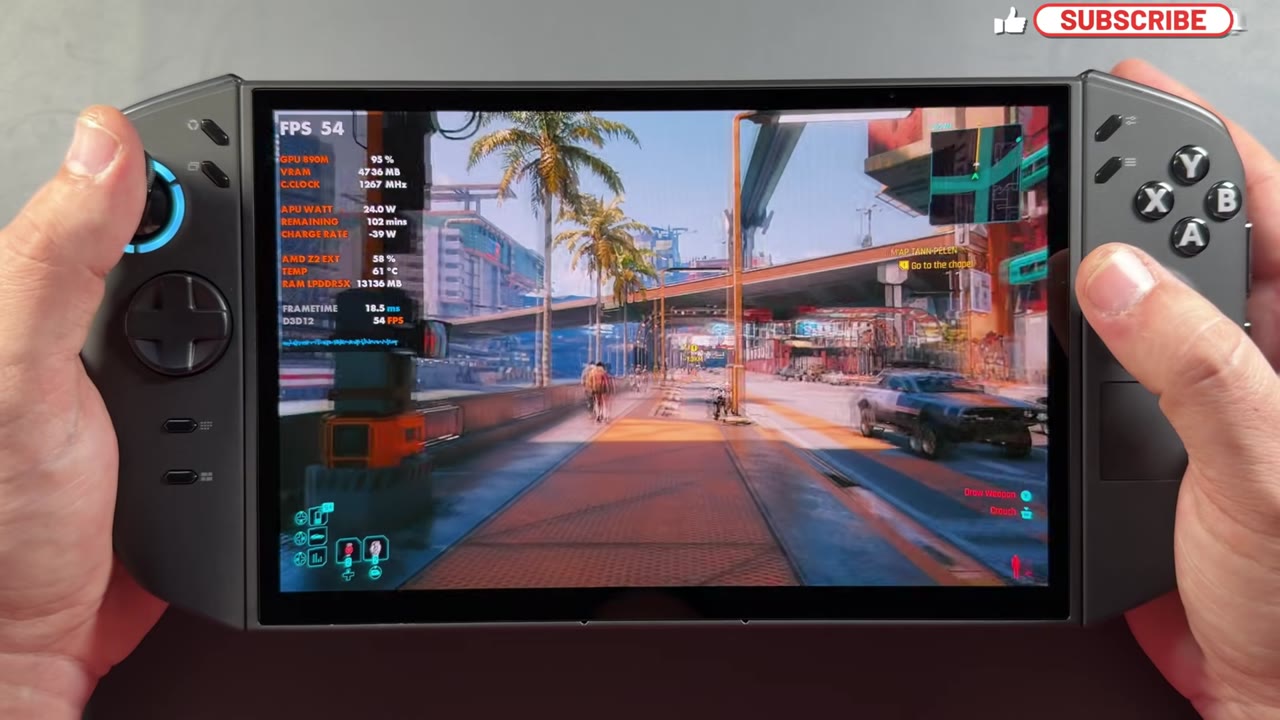
Legion Space
Much like ASUS's Armoury Crate SE and Command Center, Legion Space has the main app and a quick access menu for settings, button mapping and that type of thing. It has become a really good, useful piece of software since the launch of the original Go. The quick access menu isn't as buggy as it used to be and gives easy access to a lot of commonly used settings. There's always more work to do with features and bug fixes, but it's much better than it was just a couple of years ago.
Battery life
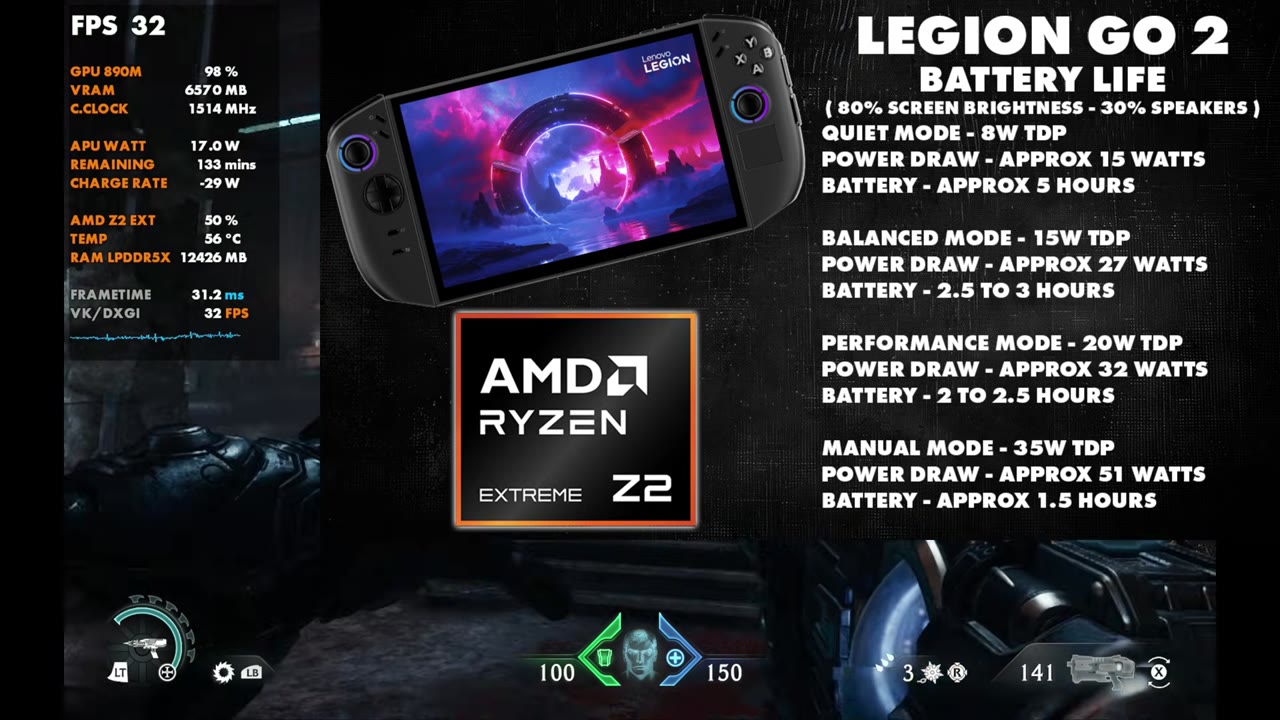
Battery life is a big part of the story with the Z2 Extreme generation. It's a much more efficient chip than the Z1 Extreme, giving more battery life and more gaming performance in the lower TDP range. Here's what I saw with the 74Wh battery:
- Quiet mode: about 8W TDP, 14 to 15W total power draw, about 5 hours
- Balanced mode: 15W TDP, 26 to 27W total draw, about 2.5 to 3 hours
- Performance mode: 20W TDP, 30 to 32W total draw, about 2.5 hours
- Custom mode goes from 20 to 35W in handheld mode. At the max 35W, total draw is about 51W, for about an hour and a half, give or take.
Game performance
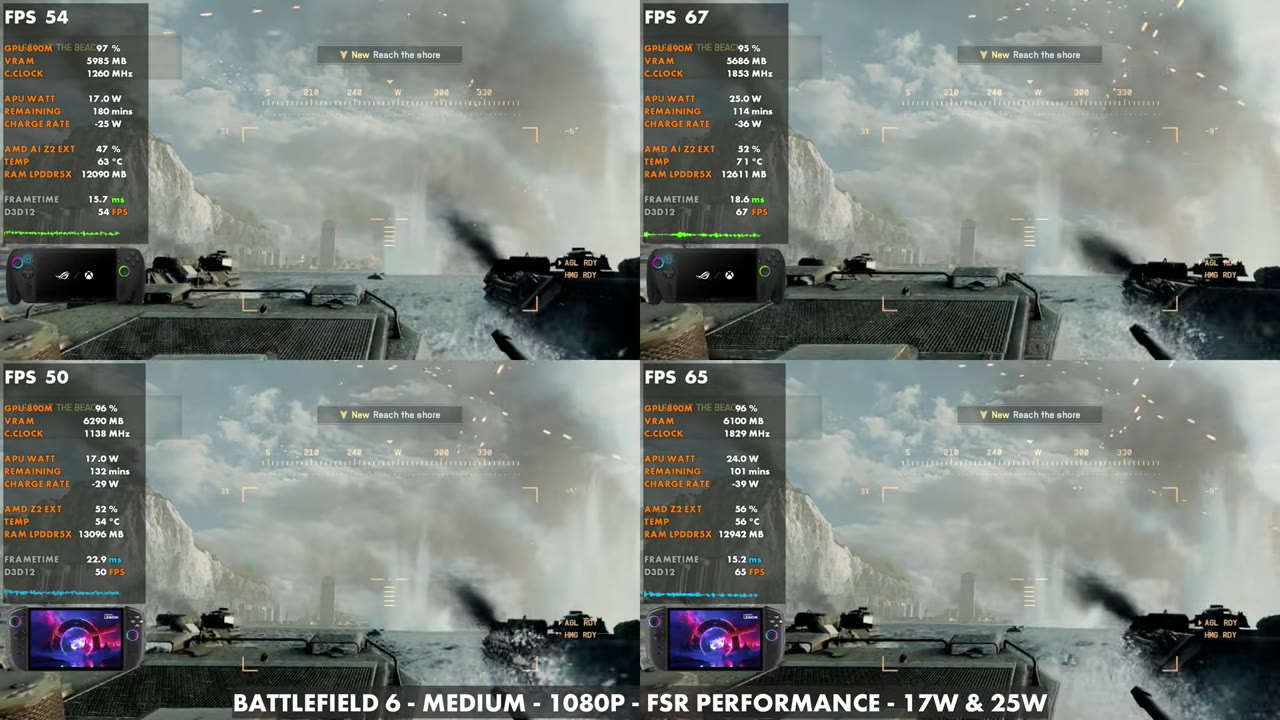
The big standout for the Z2 Extreme is its efficiency, and the 17W range has been impressive compared with the Z1 Extreme. Where I might have used 20 to 25W in games on the Legion Go, I can get away with 15 to 20W on the Legion Go 2 for similar performance and a bit more battery life, plus the bigger battery. The actual FPS leap tends to fall around 10 to 20% over the last-gen Z1 Extreme, so we still get an FPS boost while gaining efficiency. It makes me excited to see what they'll do with Gen 3 if this chip is doing so well on efficiency.
The review shows real-world performance in games like Battlefield 6, Doom: The Dark Ages, Shadow of the Tomb Raider, Assassin's Creed Shadows and Forza Horizon 5, mostly at 17W and 25W. I'm holding on to this device for the next one to two years, so a lot more game testing is coming.
The price
At $1,349 USD, or $1,440 with tax for me, the Legion Go 2 Z2 Extreme is pretty much exactly twice the cost of the original Go at its $699 launch two years ago. Back then I really praised Lenovo for bringing such a well-built PC handheld to the mainstream for a good price. There are many reasons tech is much more expensive just two years later, but this isn't the direction I want to see from mainstream companies like Lenovo and ASUS, who I want bringing these devices to more of the mainstream market for less money. Lenovo itself said this device is made for the enthusiast and built with them in mind, hence the OLED VRR HDR display, among other changes that increased the price.
For about $300 less, you could get the Z2 version and keep the OLED screen and everything else premium about the device. Keep in mind, though, that the Z2 is a renamed Z1 Extreme. The only new architecture in AMD's stack is the Z2 Extreme and the AI Z2 Extreme, and pretty much everything under those is a renamed older chip. If the screen isn't a big selling point for you and you're in more of a $1,000 price range, you might want to look at the Xbox Ally X or the MSI Claw 8 AI+.
I believe many people buying or looking at this device are doing it for the 8.8-inch OLED with VRR, and it really is an amazing screen. I don't get flicker issues, VRR works really well, I haven't had issues with the mirror effect or a dirty panel, and it even does HDR really well. For a lot of people, that will be the reason to look at this and try to justify the price.
Verdict
The Lenovo Legion Go 2 is a premium, well-built PC handheld that improves on the original in every way. The Ryzen Z2 Extreme feels much better to use and game on in person than it looks on paper, or than I thought it would. What I said about the original Go still holds, though: with its size, weight and the way it's built, it's more of a multi-function device than just a gaming handheld. Depending on who you are, that might help justify the cost, along with the 8.8-inch OLED, which is no doubt a big factor in the higher price. Lenovo committed to that display, and in my opinion they nailed it. It's beautiful in person and has HDR you can actually use.
There are a lot of great PC handhelds out there now, most ranging from $500 to $1,000, so many people on a budget could find something else, or something used, that would work really well for them. But if you've been waiting on this device from Lenovo, with the OLED screen, good VRR and the newest Z2 Extreme chip, and you're comfortable paying in the $1,000 to $1,500 range for a PC handheld, it's absolutely going to serve you well.
Three months later, I checked back in: Legion Go 2 Z2 Extreme 3 Months Later.
Want more handheld tests?
New Steam Deck, ROG Ally, Legion Go and Steam Machine performance videos every week.