 ▶Watch on YouTube
- The ROG Xbox Ally X and ROG Xbox Ally X20 use the same AMD Ryzen AI Z2 Extreme, 24GB of LPDDR5X, 1TB SSD and 80Wh battery. These tests are all at 1080p with matched custom settings.
- Because of the cooling, and probably some other design tweaks, the X20 tends to pick up a little more performance and definitely runs a lot cooler. It reminds me of Steam Deck OLED versus LCD: sometimes 1 to 3 FPS more, sometimes just cooler.
- Official in-game benchmarks in Cyberpunk 2077, Forza Horizon 6 and Assassin's Creed Black Flag Resynced give the X20 a small lead, more noticeable at 17W. At 35W in Cyberpunk the official averages were essentially tied (59.72 vs 59.80), with the X20 much cooler.
- I tested 17W and 25W in all four games, and 35W only in Cyberpunk. The X20 is $300 more ($1,299.99 vs $999.99), with a 7.4-inch OLED instead of the Ally X's 7-inch IPS LCD.
I've still been wrapping up my official review of the ROG Xbox Ally X20, and I wanted to put the original Xbox Ally X next to it in some harder-to-run games. On paper they're the same performance device. Both use the AMD Ryzen AI Z2 Extreme, with the same 24GB of LPDDR5X, the same 1TB SSD and the same 80Wh battery. Both are running 1080p here. The difference is everything around that hardware, especially the screen and the cooling.
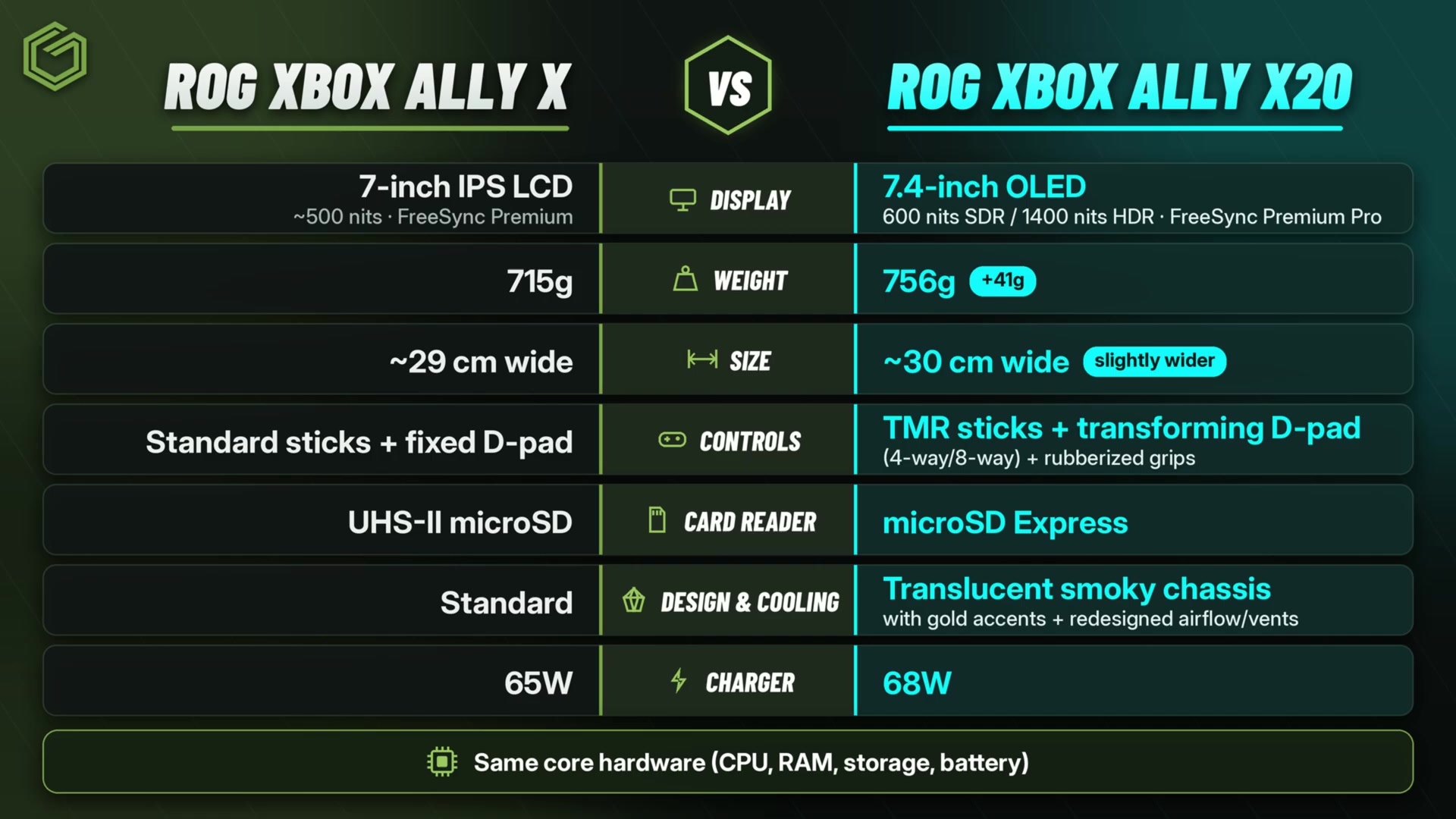
The X20 has a 7.4-inch 1080p 120Hz OLED, listed at 600 nits SDR and 1400 nits HDR, with Dolby Vision and FreeSync Premium Pro. The Ally X has a 7-inch 1080p 120Hz IPS LCD, about 500 nits, with FreeSync Premium. The X20 is a little heavier at 756g versus 715g, and a little wider. It also has TMR sticks, a transforming 4-way/8-way D-pad, rubberized grips, microSD Express and a 68W charger instead of 65W. The OLED is definitely wonderful, the grips feel great, and the joysticks, D-pad and buttons all feel better than the original. I'll go deeper on that in the full review. For an earlier look at the hardware, I also have an unboxing and first look.
What I tested
All four games ran at 1080p (1920x1080) with 8GB VRAM and matched custom settings on both handhelds. Frame generation was off in every game. I used 17W and 25W in all four, and I also ran some 35W in Cyberpunk 2077. The driver showing on the Cyberpunk and Black Flag results screens was Radeon software 26.10.1, on Windows 11 Home.
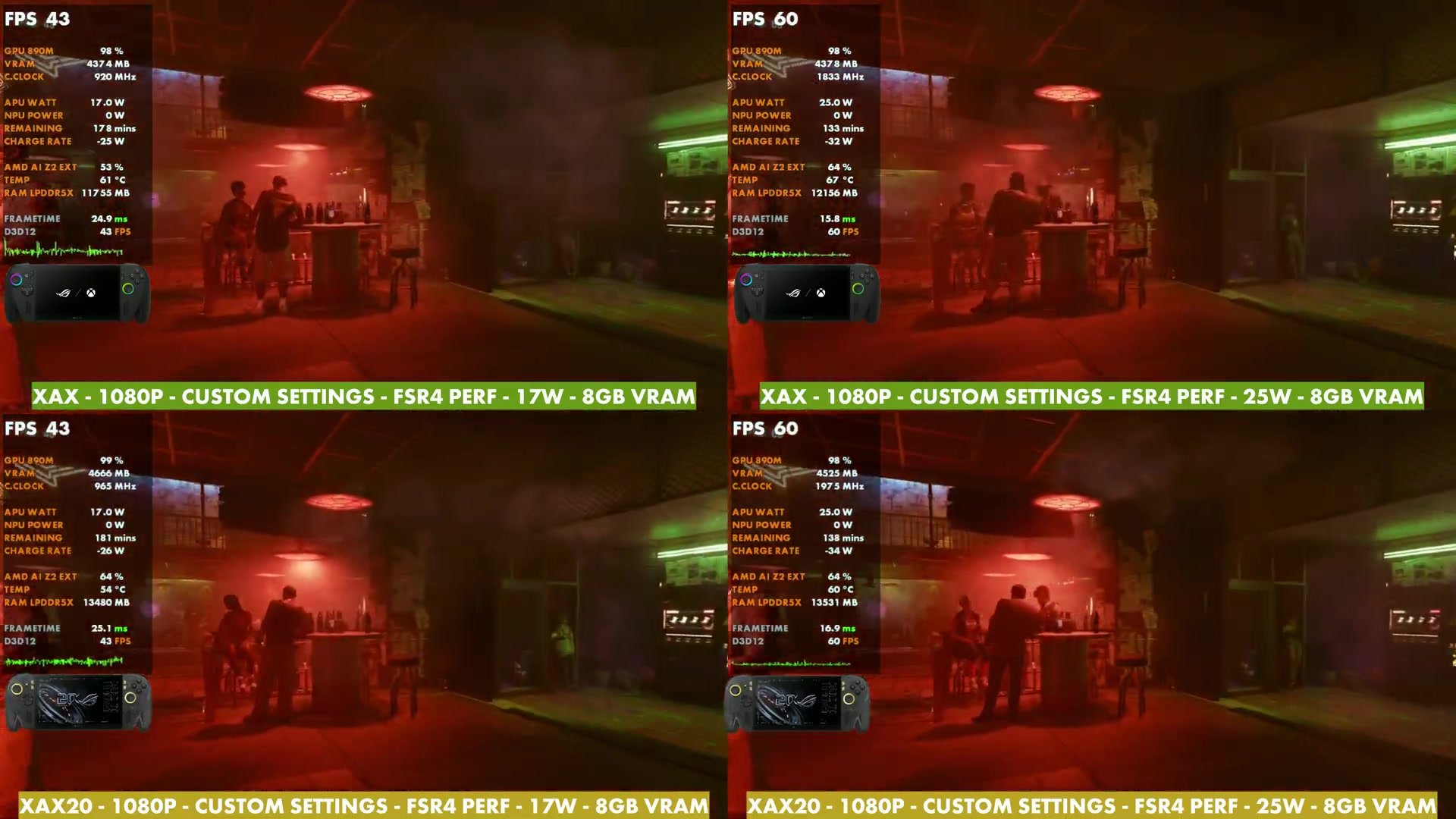
When the video is a four-way split, the Xbox Ally X is on top (green labels) and the Xbox Ally X20 is on the bottom (yellow labels), with 17W on the left and 25W on the right. Two-way clips are the Ally X on the left and the X20 on the right, at one TDP at a time. FPS numbers below are from the on-screen overlay unless I call out an official in-game benchmark result. The overlay FPS on a results screen is just that moment's frame rate, so I used the official average (or Forza's Achieved figure) for those benches, not the overlay number in the corner.
| Game | Upscaler | TDPs tested |
|---|---|---|
| Cyberpunk 2077 | FSR 4 Performance | 17W, 25W and 35W |
| Gears of War: E-Day | FSR 4 Performance | 17W and 25W |
| Forza Horizon 6 | FSR 4.1.2 Balanced | 17W and 25W |
| Assassin's Creed Black Flag Resynced | AMD FSR Performance | 17W and 25W |
Official benchmark summary
Three of the four games showed a built-in benchmark results screen. Gears of War: E-Day did not, so that one is overlay readings only, later in the article.
| Game | Result | TDP | Xbox Ally X | Xbox Ally X20 |
|---|---|---|---|---|
| Cyberpunk 2077 | Official average | 17W | 44.05 | 45.55 |
| Cyberpunk 2077 | Official average | 25W | 58.87 | 59.20 |
| Cyberpunk 2077 | Official average | 35W | 59.72 | 59.80 |
| Forza Horizon 6 | Official Achieved | 17W | 34 FPS | 36 FPS |
| Forza Horizon 6 | Official Achieved | 25W | 42 FPS | 44 FPS |
| Black Flag Resynced | Official average | 17W | 39 | 43 |
| Black Flag Resynced | Official average | 25W | 46 | 49 |
That matches what I was seeing in real gameplay too. 17W tends to gain a little more than the higher wattages, because of GPU clock speeds, especially in real-world gameplay and not so much in every benchmark. Going from 25W to 35W in Cyberpunk barely moved the official average on either handheld, but the X20 stayed a lot cooler.
Cyberpunk 2077
Custom preset at 1080p fullscreen, VSync off, maximum FPS off, HDR off. AMD FidelityFX Super Resolution 4 was set to Performance, with FSR 4 sharpness at 0 and frame generation off. FSR Anti-Lag 2 was on. Ray tracing and path tracing were off. Texture quality was Medium, crowd density Low, FOV 80, anisotropy 8, and contact shadows on. Most of the other quality options were Medium, with distant shadows at Low, and film grain, chromatic aberration, depth of field, lens flare, motion blur and vignette off.
In the four-way gameplay, the two handhelds were often close. Overlay samples at 17W were mostly in the high 30s to mid 40s (about 38–44 on the Ally X and 41–48 on the X20). At 25W they were mostly in the 50s to low 60s (about 53–62 and 50–63). In the bar scene below, both read 43 FPS at 17W and 60 FPS at 25W on the overlay, but the X20 was cooler and holding a much higher GPU clock at 17W (1660 MHz versus 920 MHz) and a higher clock at 25W as well. Overlay temperatures in that scene were 61°C and 67°C on the Ally X, versus 54°C and 60°C on the X20.
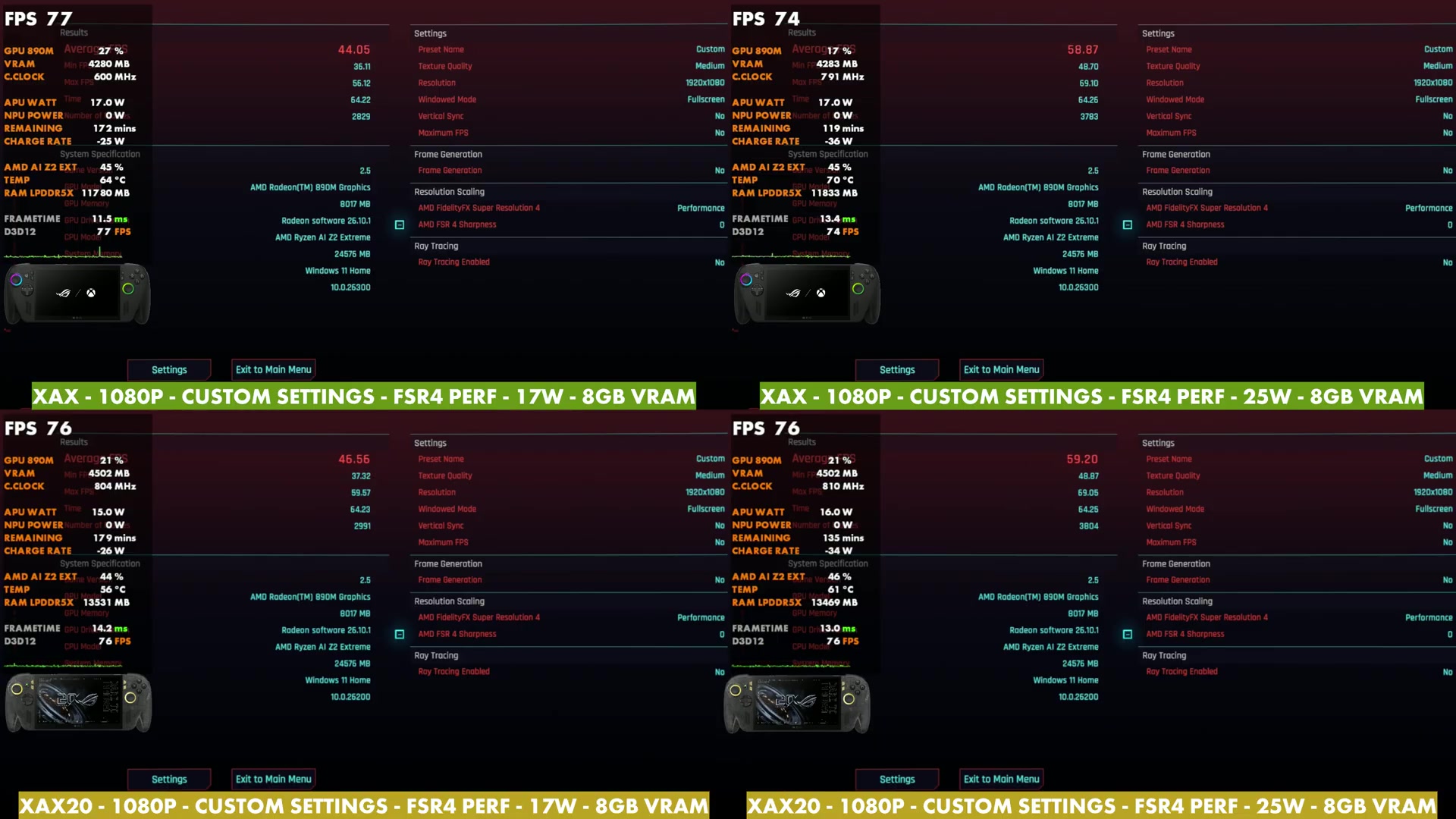
The official 17W and 25W benchmark results:
| Device | TDP | Average | Min | Max |
|---|---|---|---|---|
| Xbox Ally X | 17W | 44.05 | 36.11 | 56.12 |
| Xbox Ally X20 | 17W | 45.55 | 37.32 | 59.57 |
| Xbox Ally X | 25W | 58.87 | 48.70 | 69.30 |
| Xbox Ally X20 | 25W | 59.20 | 48.87 | 69.06 |
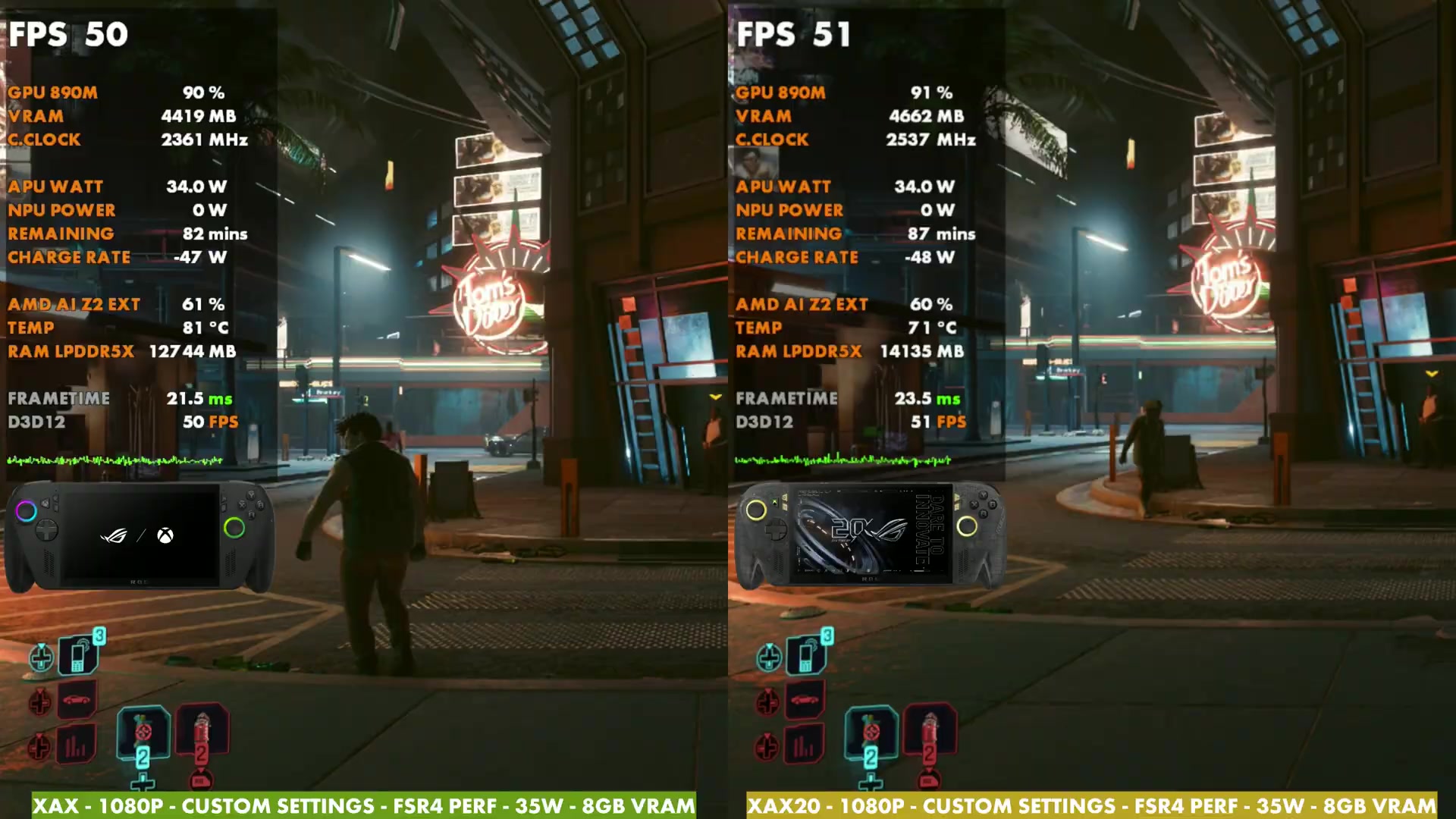
Then I ran 35W as a two-way. In gameplay the overlay was often in the high 50s to low 60s and pretty much tied, and in a later street scene it sat around 50 and 51. Clocks were still higher on the X20 (2537 MHz versus 2361 MHz in the frame below), and the temperature gap was obvious: 81°C on the Ally X and 71°C on the X20, both at 34W on the overlay.
| Device | TDP | Average | Min | Max |
|---|---|---|---|---|
| Xbox Ally X | 35W | 59.72 | 48.72 | 70.40 |
| Xbox Ally X20 | 35W | 59.80 | 49.21 | 69.92 |
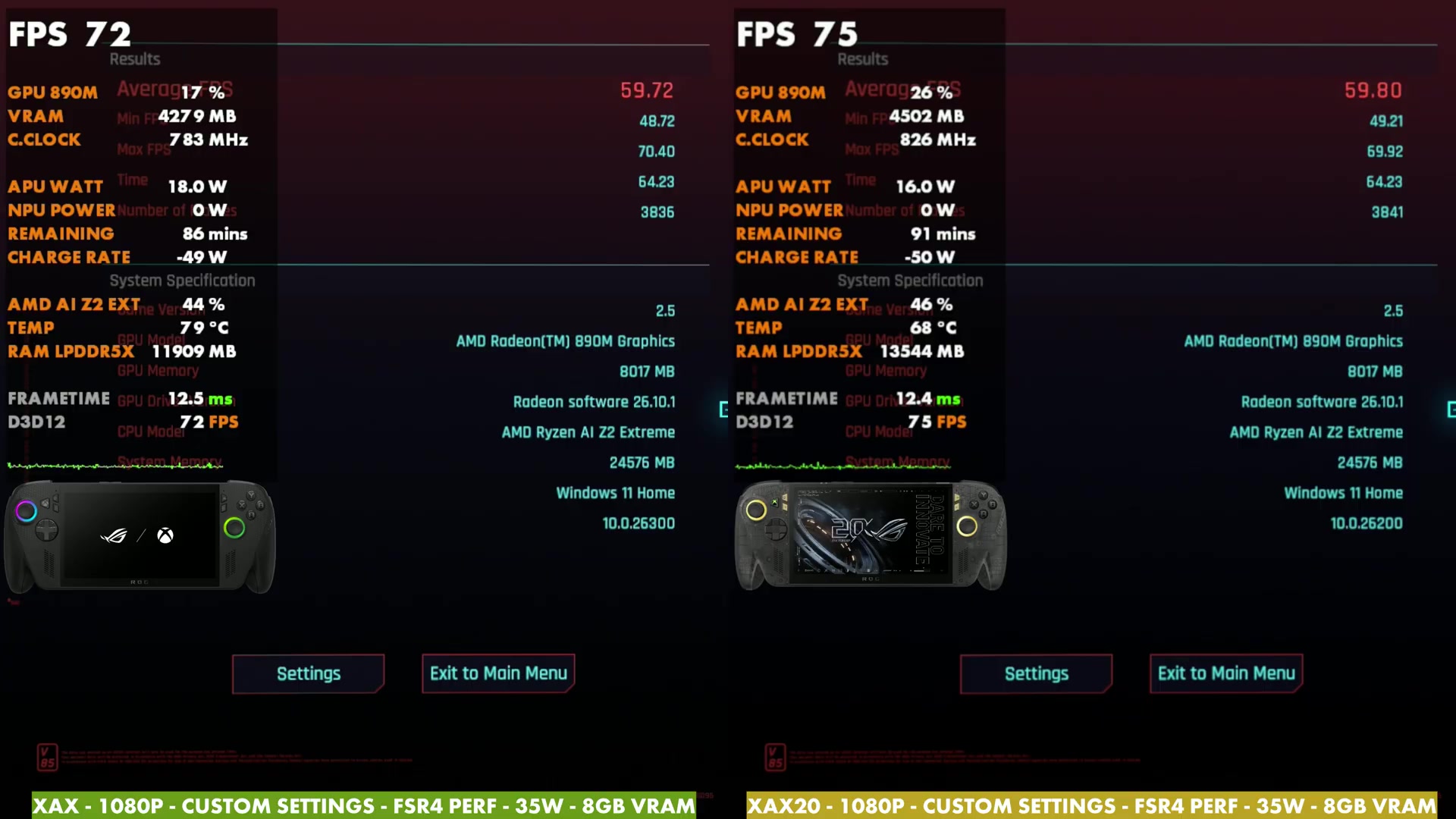
Two-way overlay gameplay at 17W and 25W stayed in that same pattern: close FPS, with the X20 usually a frame or two ahead and running cooler. At 17W, overlay samples were about 36–40 on the Ally X and 38–43 on the X20. At 25W both were mostly in the mid 40s, often within 1 or 2 FPS.
Gears of War: E-Day
This is another 1080p custom pass with FSR 4 Performance, frame generation disabled, and Anti-Lag 2 on, similar to the setup in my Xbox Ally X Gears of War: E-Day test. Exclusive full screen, VSync off, max FPS unlimited, FOV 80. Effects, textures and postprocessing were Medium, geometry Low, motion blur off, and most of the heavier options (global illumination, reflections, volumetric fog, ray-traced shadows, sunlight shadows, gore) were Low, with subsurface scattering at Medium.
There was no official results screen in this comparison, so these are overlay readings. In the four-way, 17W samples were about 25–34 FPS on the Ally X and 28–35 on the X20. 25W samples were about 33–48 and 32–47. The frame below is a typical mid-range moment: 29 and 40 on the Ally X, 30 and 40 on the X20, with the X20 cooler (59°C / 67°C versus 55°C / 60°C) and at higher clocks.
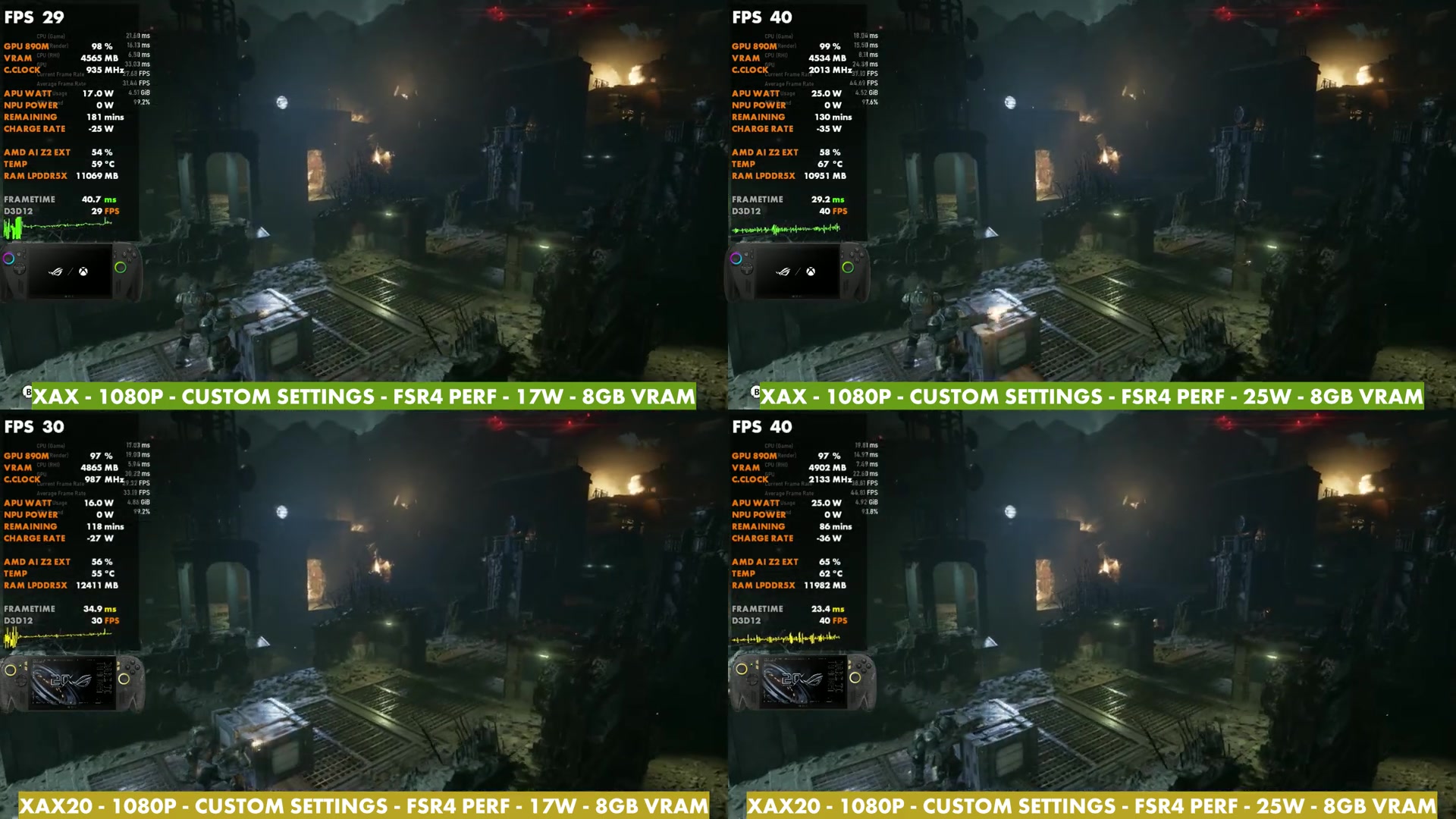
The two-way clips told the same story. At 17W, overlay samples were about 26–35 on the Ally X and 28–37 on the X20, with the X20 usually ahead by 1 to 4 FPS. At 25W they were often within a couple of frames in the low 30s to mid 40s, and it wasn't always the X20 in front. I had moments like 44 vs 43 and, later on, 37 vs 33 in the Ally X's favor, and others like 33 vs 37 and 35 vs 38 for the X20. Overlay temperatures at the end of that 25W clip were 72°C on the Ally X and 63°C on the X20.
Forza Horizon 6
1080p full screen, VSync off, frame rate unlocked, motion blur off, TAA off. Resolution scaling was AMD FSR 4.1.2 Balanced, with sharpness at 0.5. Most of the graphics options were High, including car LOD, environment textures and geometry, car reflections, screen-space reflections, shadow quality, shader quality and deformable terrain. Screen-space global illumination was Medium, and ray-traced reflections, ray-traced global illumination and night shadows were off. I also have a longer Forza Horizon 6 test on the Xbox Ally X if you want more settings context.
In the four-way gameplay, 17W overlay samples were about 28–37 on the Ally X and 32–41 on the X20. 25W samples were about 39–47 and 40–49. The official Forza benchmark results screen reported these Achieved figures, and each run was marked valid:
| Device | TDP | Official Achieved |
|---|---|---|
| Xbox Ally X | 17W | 34 FPS |
| Xbox Ally X20 | 17W | 36 FPS |
| Xbox Ally X | 25W | 42 FPS |
| Xbox Ally X20 | 25W | 44 FPS |
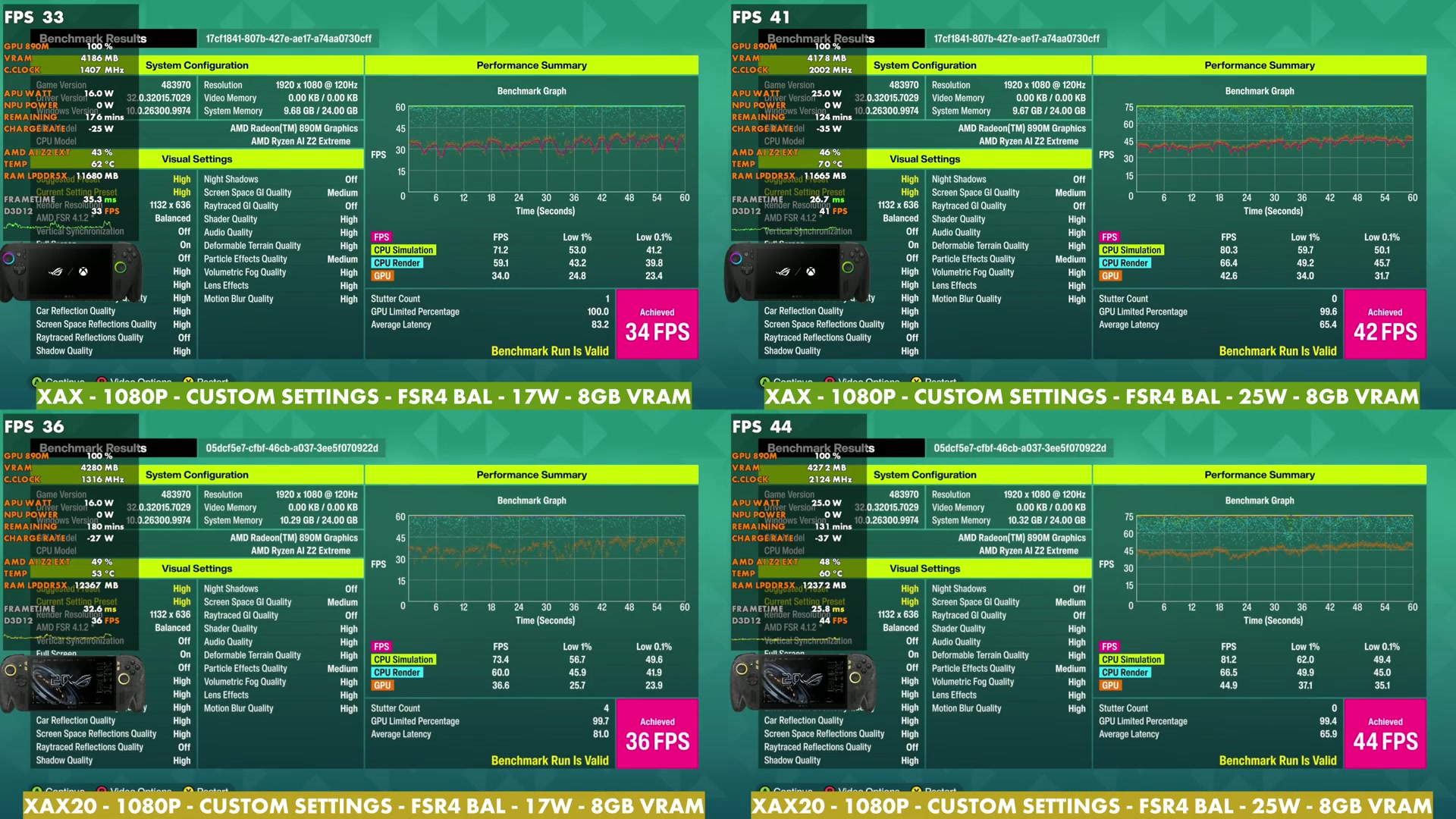
After the bench, the two-way 17W gameplay was often tied or within 1 or 2 FPS, including a heavier dip where the overlay read 24 vs 26. At 25W the X20 was typically 1 or 2 FPS ahead, for example 45 vs 46, 44 vs 45 and 40 vs 42, with one dip where the Ally X read 32 and the X20 27. Near the end of that 25W clip, overlay temperatures were 71°C on the Ally X and 62°C on the X20.
Assassin's Creed Black Flag Resynced
This one used the menu's AMD FSR upscaler, not FSR 4, at Performance quality, with sharpen strength at 25% and frame generation off. Display was borderless 1920x1080, VSync off, FPS limit off, dynamic resolution off. Ray tracing was off. Most scalability options were Medium, including characters, textures, geometry, particles, water, shadows, clouds and volumetric effects, with post effects, fog, terrain and deformation at Low, and hair strands set to player only. I previously tested Black Flag Resynced on the Xbox Ally X with a different settings mix, including handheld presets and RTGI.
In the four-way gameplay, before and during the built-in benchmark, 17W overlay samples were about 31–44 on the Ally X and 33–48 on the X20. 25W samples were about 36–55 and 38–55. Temperatures stayed in a familiar spread, around 65°C / 74°C on the Ally X versus 56°C / 64°C on the X20.
The official benchmark results, each from a 138-second session:
| Device | TDP | Average | Min | Max | 1% low |
|---|---|---|---|---|---|
| Xbox Ally X | 17W | 39 | 26 | 70 | 30 |
| Xbox Ally X20 | 17W | 43 | 31 | 71 | 34 |
| Xbox Ally X | 25W | 46 | 32 | 84 | 34 |
| Xbox Ally X20 | 25W | 49 | 33 | 80 | 37 |
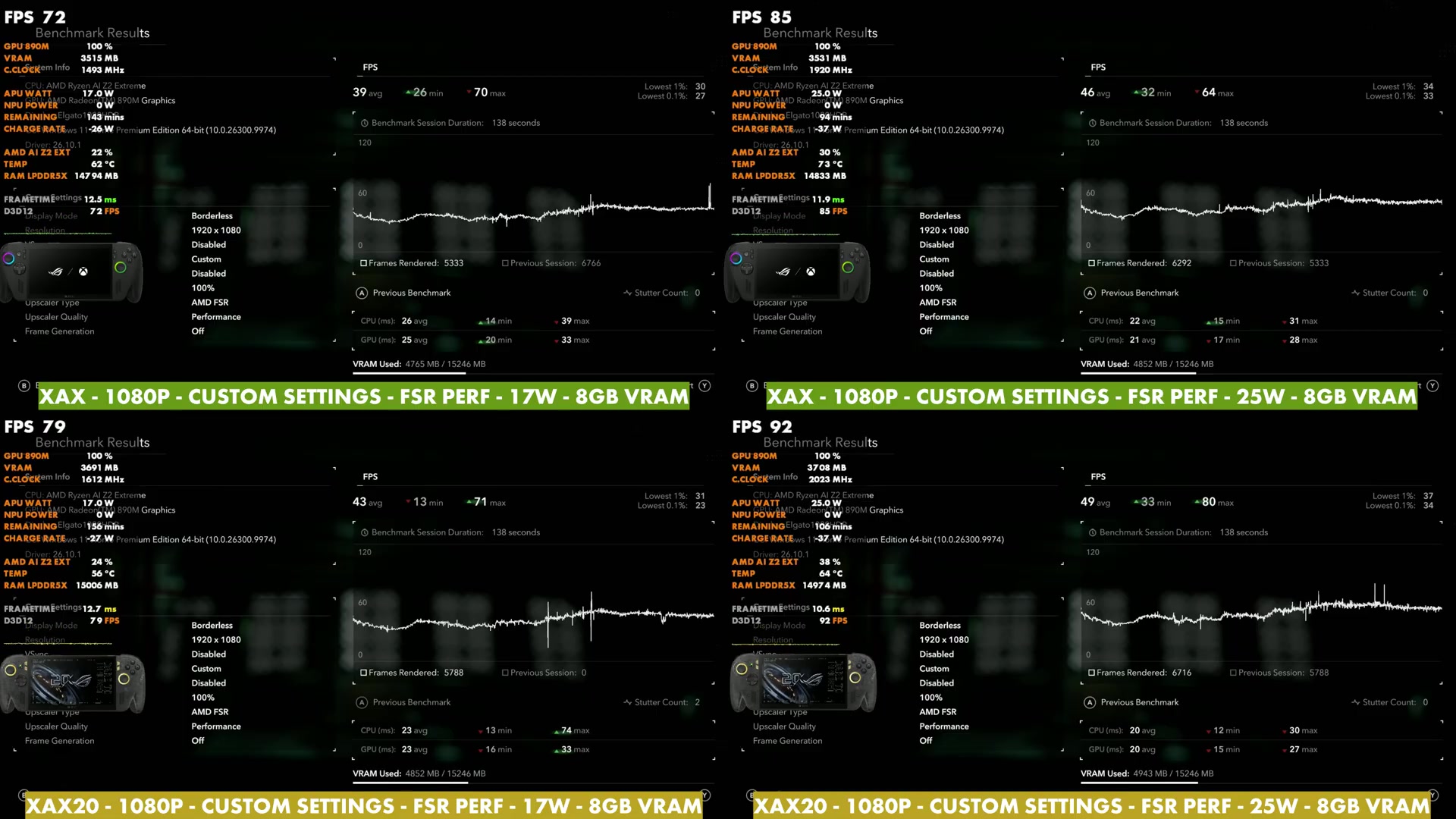
The X20 17W results screen also showed a stutter count of 2; the other three runs showed 0. After the bench I only ran 25W as a two-way. Overlay samples there were about 36–56 on the Ally X and 41–61 on the X20. The X20 was usually ahead by a few FPS, with a few moments that were tied or in the Ally X's favor, like 50 vs 45 and 48 vs 45.
What stands out
These are essentially the same performance hardware. You're not getting a faster APU, more RAM or a bigger battery on the X20. What you are getting is a better screen, better controls, and cooling that lets the same chip hold higher clocks and much lower temperatures. In these four games that showed up as a small FPS lead, more often at 17W than at 25W or 35W, and as a consistent temperature drop, often around 8 to 11°C at the same TDP.
That 35W Cyberpunk bench is a good example of the trade. The official averages were 59.72 and 59.80, so you're not buying a big FPS jump at that wattage, but the X20 was about 10 to 11°C cooler while doing it. If you've used a Steam Deck OLED next to a Steam Deck LCD, the performance gap here feels familiar: sometimes 1 to 3 FPS more, and definitely cooler.
FAQ
Is the Xbox Ally X20 faster than the Xbox Ally X?
They use the same AMD Ryzen AI Z2 Extreme, RAM, storage and battery. In these tests the X20 had a small official-benchmark lead, more noticeable at 17W (for example 44.05 vs 45.55 in Cyberpunk, 34 vs 36 Achieved in Forza Horizon 6, and 39 vs 43 average in Black Flag Resynced). At 35W in Cyberpunk the official averages were essentially tied.
Why does the X20 run cooler?
The X20 has redesigned airflow and vents, and I think the cooling is the main reason it holds higher GPU clocks. In these tests it was often about 8 to 11°C cooler than the Ally X at the same TDP, including 81°C vs 71°C in 35W Cyberpunk gameplay and 79°C vs 68°C on that 35W results screen.
Did you test 35W in every game?
No. 17W and 25W were tested in all four games. 35W was only in Cyberpunk 2077.
Were the settings the same on both handhelds?
Yes. Every game ran at 1080p with 8GB VRAM and matched custom settings, and frame generation was off. Cyberpunk 2077 and Gears of War: E-Day used FSR 4 Performance, Forza Horizon 6 used FSR 4.1.2 Balanced, and Black Flag Resynced used AMD FSR Performance.